Al- Ahram Weekly
Issue No.1187, 6 March, 2014
05-03-2014 04:07PM ET
Moscow’s move to defend its strategic interests in Ukraine belie a wider game where
Western powers aim to encircle and constrain Russia — which it will not allow,
writes Nourhan Al-Sheikh
Virtually overnight the Ukraine has turned from a stable country feeling its way
towards economic and social development to an arena of conflict that is growing more
complex and acute by the day. Only yesterday it was looking forward to signing a
partnership agreement with the EU and moving confidently towards the horizons of
prosperity and progress. Today, it is crumbling beneath the forces of deteriorating
security, spreading anarchy, a plummeting economy, and it is standing on the
threshold of civil war and the possible secession of western Ukraine, where the pro-
Washington and Europe camp prevails, from the east and south of the country where
the majority of the populace is Russian and the grassroots bases of the Russophone
Party of Regions favour closer ties with Moscow. In short, the polarisation is sharp
and it is tearing the country apart.
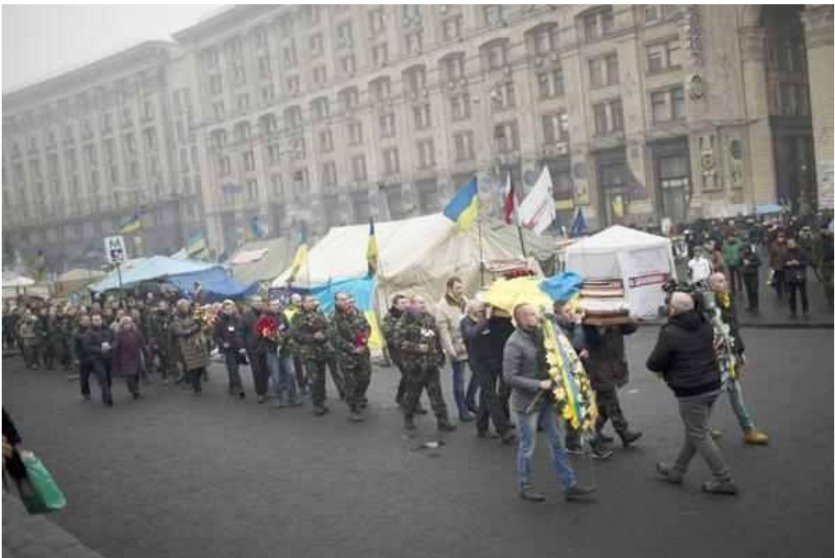
The unfamiliar scenes of violence emerging from Kiev and other Ukrainian towns
have shocked people at home as much as abroad. Few if any would have expected the
peaceful demonstrations that began on the evening of 21 November to escalate in this
way. Protesters have begun to set fire to private homes in addition to storming,
vandalising and burning courthouses and other government buildings, and pillaging
police stations, military units and arms depots. Militias and paramilitary groups have
suddenly surfaced and the clashes between them and security forces have already
claimed hundreds of casualties on both sides.
Meanwhile, relations between the Ukrainian political forces have become tenser than
ever following the ouster of the ruling Party of Regions from the presidency and the
parliament and the opposition leaders’ reneging on the agreement they had reached
with the aid of EU mediation with President Victor Yanukovych on 21 February.
After removing him from office, they transferred the powers of the president to the
new speaker of parliament, drawn from the opposition, and appointed four opposition
members in the key government posts of minister of interior, minister of defence,
chief public prosecutor and national security chief. The parliament also approved
amendments to legislation pertaining to corruption, which led to the release of the
former prime minister Yulia Tymoshenko, who then announced that she would field
herself in the next presidential elections. Yanukovych, for his part, fled to Russia,
declared the opposition’s actions a “coup” and described the actions of parliament as
“criminal”.
In spite of the political measures undertaken by the opposition, the Ukrainian streets
— and specifically Maidan Nezalezhnosti (Independence Square) in Kiev — remain
under the control of the extremist Right Sector, which does not recognise any
authority but that of its leader Dmitry Yarosh. Yarosh, whom Moscow has branded a
terrorist and entered on the international wanted list of Interpol, has called on Russia’s
most wanted terrorist, the Chechen separatist leader Doku Umarov, to support his
forces (anti-Russian forces) in the Ukraine. Thus, on top of the mounting anarchy,
Ukraine is staring at the spectre of systematised terrorism, much of it aimed at the
country’s ethnically Russian citizens who make up around 24 per cent of the
population.
The new Ukrainian authorities’ inclination to favour big business and award business
magnates with key government posts is also likely to inflame popular anger, creating
yet another destabilising factor. There have already been signs of this with the mass
protests that erupted following the appointment of prominent businessmen as
governors.Colomwksa and Tarotta, who were awarded the governorships of the
provinces of Donetsk and Dnepropetrovsk, have entered the lists of the richest men in
the Ukraine and Eastern Europe. Moreover, popular wrath will mount if the new
government carries out the conditions of the IMF, as the prime minister said it would,
for obtaining loans from the international funding agency. The IMF recipe will lead to
major hikes in the prices of fuel and energy and foodstuffs.
Meanwhile, secessionist tendencies in the east and south of Ukraine have been fuelled
by the parliament’s latest move to abolish Russian as a local language in half of the
country’s provinces and by acts of violence perpetrated against ethnic Russians in
these areas. This applies, in particular, to the Crimean peninsula where the prime
minister of the semi-autonomous Republic of Crimea has set a referendum on the
status of this region for 30 March and tightened security around government and
security infrastructure there. In addition, the Ukrainian military and naval command
in Crimea has declared its independence from the new authorities in Kiev and its
support for the authorities in Crimea. The chiefs in Ukraine are multiplying and the
control and prestige of the central government in Kiev is eroding further.
The situation in Ukraine is not a purely domestic crisis. International power struggles
and the interventions of world powers have had a visible hand in fuelling it. The
rivalry between Washington and Moscow has been especially instrumental. Although
the ideological competition between the two sides faded with the collapse of the
Soviet Union and while they since reached a number of understandings and expanded
their realm of mutual interests, they still have vying strategic and economic interests
and this conflict has been playing out in the Ukraine among other places.
Following Ukraine’s “Orange Revolution” in 2004, which received Washington’s
blessing and support, it became clear that the US planned to settle Ukrainian identity
in its favour and include it in the NATO security system. Towards this end, it worked
to counter and eventually eliminate Russian influence in that country. In fact, NATO
began to discuss annexation of the Ukraine in its 2008 summit. However, the matter
had to be deferred due to the eruption of the South Ossetia crisis and the Russian-
American facedown over Georgia.
It therefore came as no surprise that Washington and Brussels backed the protesters in
Ukraine from the start of the crisis. Since then there has been a constant stream of
Western political luminaries arriving to Independence Square where they met with
Ukrainian opposition leaders. Among the high profile visitors were EU High
Commissioner for Foreign Affairs and Security Catherine Ashton, US Assistant
Secretary of State for European and Eurasian Affairs Victoria Nuland who, together
with the US ambassador there, handed out bread to the demonstrators in the square,
and US Secretary of State John Kerry who, together with European ministers, met
with Ukrainian opposition leaders on several occasions. Note, too, that the acting
minister of defence in Ukraine was invited to attend the NATO defence minister’s
meeting on 26 February to discuss the situation in his country even though Ukraine is
not a member of the pact.
Naturally, Russia could not be expected to stand by and watch the erosion of its
influence in a strategically vital area. Sivastopol on the Crimean peninsula has long
served as the base for the Russian fleet on the Black Sea through which it can access
the warm waters of the Mediterranean through the Bosphorus. Although the Ukrainian
opposition had begun to clamour for a Russian departure several years ago, in April
2010 the Ukrainian parliament voted to renew the agreement with Moscow over
Sivastopol for another 25 years starting from 2017.
The foregoing backdrop helps explain mounting Russian-American tensions
following Washington’s recent threats to Moscow and the latter’s response to the
provocation. The escalation between the two powers, in turn, aggravated the crisis and
sharpened the polarisation in the Ukraine. Russian President Vladmir Putin has
warned that his government would act to defend its interests and those of its citizens
and Russian-speaking Ukrainians in the event that the violence spreads to eastern
Ukraine and the Crimea. In an unanimous vote on 1 March, the Russian Federal
Assembly approved Moscow’s right to deploy military forces to restore political and
social stability in the Ukraine. The following day NATO held an emergency meeting
to discuss this development. Back in Washington, Obama warned that Moscow would
be violating international law by intervening in the Ukraine and Kerry described
Moscow’s actions as “aggression” and hinted at the possibility of sanctions. In
addition, the meeting of the G-8, scheduled to be held in Sochi in June, was
postponed.
US threats are unlikely to deter Moscow, especially given the strategic importance of
the Ukraine and the Crimean peninsula. While Washington continues to act with the
mentality of the world’s sole superpower that all must obey, Moscow has steadily
been gaining in stature and influence regionally and internationally, and it has shown
itself capable of defending its interests and allies, as well as of checking and
outmanoeuvring the US on a number of regional and international issues. In addition,
it could draw on its membership in a number of economic cooperation blocs, prime
among which is BRICS, which also includes China and India — the world’s second
and third largest economies — as well as South Africa and Brazil. We should also
recall that the confrontations between Russia and the US during the South Ossetia
crisis in 2008, and more recently during the Syrian crisis, demonstrated that the
language of intimidation does not work when it comes to Moscow, and that dialogue,
negotiation and compromise are the best means to contain a crisis and forestall a
massively destructive clash from which all would emerge as losers.
Russia does not want war; that is certain. But the Ukraine for Russia is not what
Obama might call a “battle of choice”. Not only is the Ukraine an important strategic
ally for Moscow, it is a natural geographic extension of Russian territory. Were it to
fall into the Euro-Atlantic orbit Russia would lose a large and vital chunk of its
backyard and unhampered access to the Black Sea, while Washington will have
tightened its encirclement of Russia and US influence in the area would spread
without restraint. The Russian military and strategic vision for 2010-2020 has
identified the expansion of NATO and its military infrastructure up to the borders of
Federal Russia as a major national security threat. It would regard Western actions
towards this end as hostile acts aimed to isolate Russia and cut it off from Europe and,
therefore, acts that Moscow would not tolerate.
At one level, the Ukrainian crisis, as was the case with the South Ossetia and Syrian
crises, can be seen as a chapter in the birth of a new global order. The second decade
of the 21st century marks the beginning of a new era in international relations that
will bring the gradual transition towards a multipolar order with a clear Asian accent.
The US star began its eclipse in the middle of the previous decade as US hegemony
receded as the result of economic strains at home and the relative failure of its
campaigns abroad, especially in Iraq. At the same time, the economic balances of
power have begun to tilt towards Asia in light of the economic crisis that rocked the
united Europe project and in view of the soaring economic capacities of Russia, China
and other important Asian forces, which aspire for a more influential role in the
framework of a more balanced and just international order.
Certainly, the shifting balances of power and, specifically, Russia’s success in the
course of the last decade in rectifying the balance of US-Russian relations, which was
heavily skewed against Moscow following the collapse of the Soviet Union, will have
an impact on the course of the Ukrainian crisis. This crisis has been allowed to grow
dangerously out of hand. However, the only way to resolve it is through a political
settlement that will pave the way for a legitimate elected authority that respects
Kiev’s special relationship with Moscow while simultaneously striking as healthy a
balance as possible in its relations with both Russia and the West.